
Identify your baobab before deciding where it can grow
Identify African baobab trees, distinguish young plants from adults, and decide whether your climate supports outdoor planting or protected container growing.
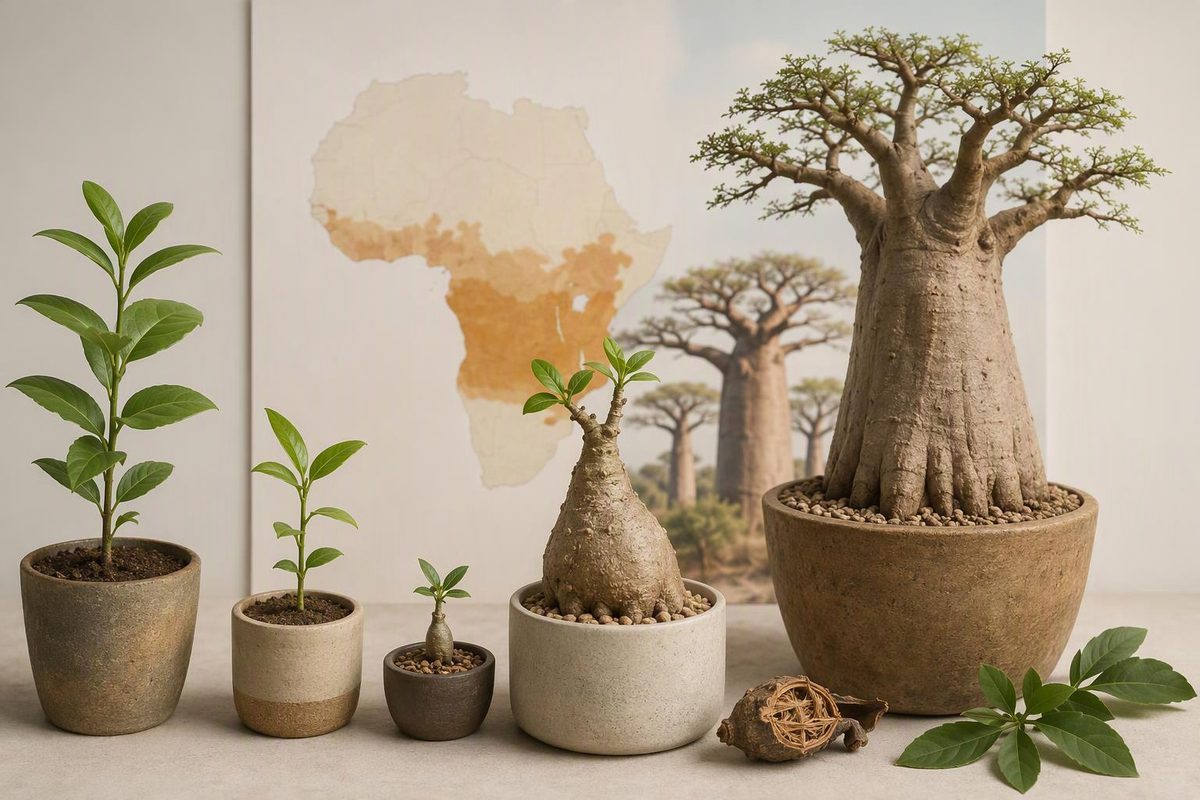
By Gardener Tips
An African baobab is a tree for warm, frost-free conditions—not a hardy garden tree for cold winters. In a colder climate, a young plant can be grown in a movable container with warm winter shelter, but that is not a promise of permanent houseplant suitability. First establish which baobab you have, then assess frost, drainage and eventual size.
Which baobab are you looking at?
“Baobab” refers to the genus Adansonia, rather than one species. A 2024 research summary from Wuhan Botanical Garden recognises eight living species, six restricted to Madagascar. The African baobab is Adansonia digitata; the Australian boab is Adansonia gregorii. A label saying only “baobab” is therefore not enough for species-specific growing advice.
For an adult African baobab, look for a combination of these features:
- A massive, usually squat trunk with greyish-brown bark that is often smooth, though older bark can be folded or seamed.
- Thick, tapering branches that give a leafless tree its familiar “upside-down” appearance.
- Leaves divided into five to seven finger-like leaflets radiating from one point.
- Large, hanging white flowers, followed by egg-shaped fruits with a hard shell and yellowish-brown hairs.
These features are described in SANBI’s African baobab profile. They are useful together; a swollen trunk alone is not a reliable species identification.
Young plants can look quite different. SANBI notes that African baobab seedlings have thin stems and simple, undivided leaves. Do not reject a seedling as wrongly labelled just because it lacks the giant trunk or divided foliage of an adult.
The Australian boab is a different species. Western Australia’s Florabase describes A. gregorii as a deciduous tree with a bottle-shaped trunk, typically 5–15 metres tall. If the label identifies an Australian or Malagasy species, obtain guidance for that exact species instead of transferring A. digitata advice automatically.
Can an African baobab stay outdoors year-round?
The decisive limitation is cold. Missouri Botanical Garden lists A. digitata as frost-intolerant and gives Zones 10b–12 in its detailed cultivation guidance. SANBI is more direct: it cannot tolerate even mild frost, and cultivation sites should be frost-free without cold winters.
Use that zone range as an initial screen, not permission to plant. A warm summer does not compensate for a freezing winter night. Nor does a frost-free location settle the drainage question: Missouri Botanical Garden identifies waterlogged soil as a cause of root rot, while SANBI recommends well-drained ground.
| Your conditions | Practical decision |
|---|---|
| Warm year-round, frost-free, sunny, well-drained, with room for a large tree | Consider outdoor planting of a confirmed A. digitata. Check local mature specimens and species-specific advice before committing. |
| Frost or cold winters, but a warm, sunny indoor space or heated glasshouse is available | Consider a young container plant that can be moved under cover before cold weather. |
| Cold winters and no suitable warm winter shelter | Do not plan on keeping an African baobab outdoors year-round. |
| Ground remains waterlogged | Resolve drainage before planting; drought tolerance does not mean tolerance of saturated roots. |
Allow substantial space: SANBI describes African baobabs reaching about 25 metres tall, with exceptionally large trunks.
For the broader distinction between winter survival and seasonal planting dates, see hardiness zone versus frost date.
What container growing does—and does not—solve
SANBI says African baobab saplings can grow in containers for many years and be moved into a warm glasshouse or indoors behind a sunny window to avoid frost. It warns that they eventually become too large and need planting in the ground. That advice concerns growing saplings; Missouri Botanical Garden also lists bonsai as a suitable use. Before buying a tree to grow on, decide how you will move the pot and what happens when it outgrows its winter accommodation.
For A. digitata, provide full sun and a freely draining growing medium. Missouri Botanical Garden recommends regular watering during the growing season and a period of dry winter dormancy. Reduce watering during that dormant period rather than keeping the root zone persistently wet.
Leaf loss alone is not proof of failure: African baobabs naturally shed their leaves during the dry season. The Australian boab is also seasonally deciduous, as Kings Park explains. Do not respond to a leafless tree by automatically increasing watering.
Before buying, confirm the botanical name, winter shelter and long-term space. If any of those is unresolved, pause the purchase rather than assume a spectacular tropical tree will adapt to the site.