
Choose St. Augustine fertilizer by soil needs—not the brand name
Choose fertilizer for an established St. Augustine lawn using soil tests, slow-release nitrogen, the right application rate and local growing conditions.
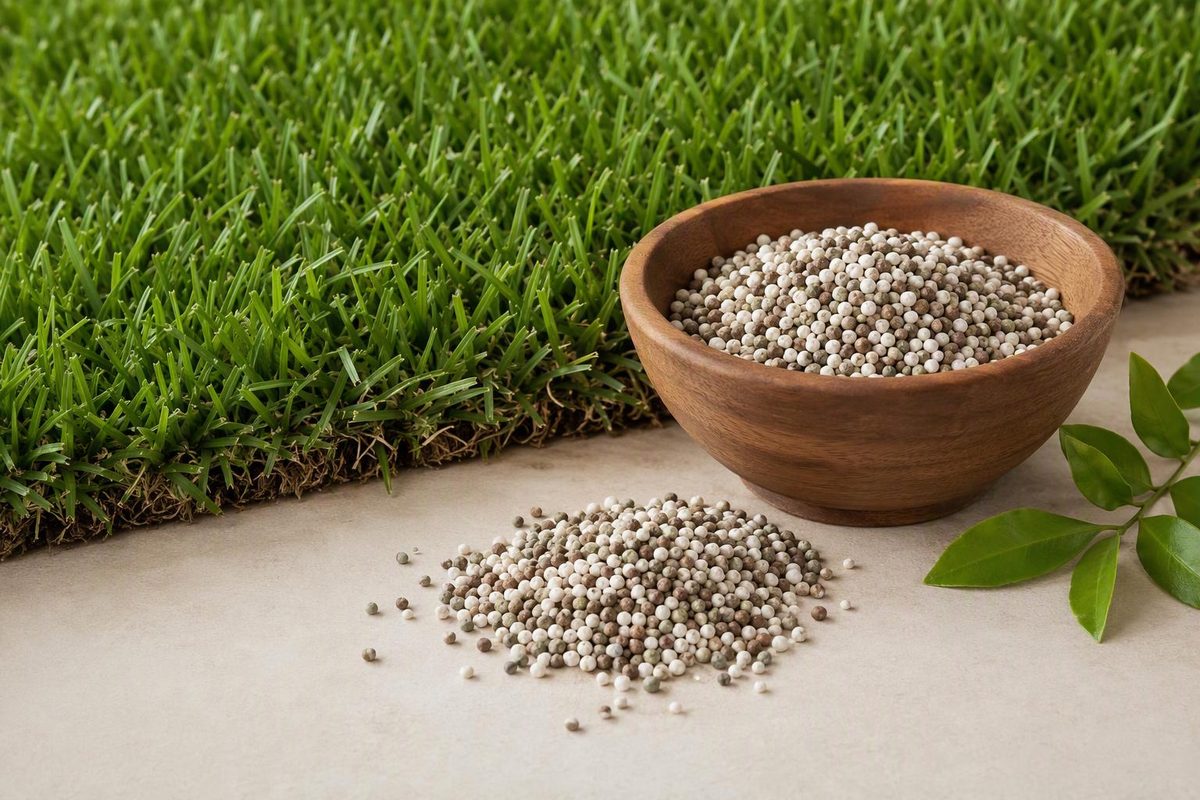
By Gardener Tips
For routine feeding of an established St. Augustine lawn, look for a lawn fertilizer with some slow-release nitrogen, no phosphorus unless a soil test recommends it, and potassium matched to the soil’s needs. A formula such as 15-0-15 can fit when phosphorus is sufficient and potassium is needed; it is not the best formula for every lawn.
That recommendation follows UF/IFAS guidance on fertilizer sources and Clemson’s St. Augustinegrass program. The useful comparison is between nutrient content and release type—not brand names.
Match the fertilizer to your soil
Before buying, request a soil test through your local Extension service or a laboratory that provides turf recommendations. Identify the grass as St. Augustine and ask for phosphorus, potassium and pH guidance. Texas A&M AgriLife strongly recommends soil testing, noting that a customary fertilizer ratio can add phosphorus the lawn does not need.
Use the results to narrow your choice:
| Soil result or lawn condition | What to look for |
|---|---|
| Phosphorus is sufficient; potassium is needed | A zero-phosphorus lawn fertilizer with potassium. A 15-0-15 product is one option if its application rate supplies the recommended nutrients. |
| Phosphorus and potassium are sufficient | A nitrogen-only lawn fertilizer, preferably with a slow-release component, rather than adding more of both nutrients. |
| Phosphorus is deficient | A phosphorus-containing fertilizer that supplies the amount recommended by the test and complies with local rules. |
| Yellowing with high soil pH | Investigate iron or manganese deficiency before increasing nitrogen. |
Clemson recommends adding phosphorus only when supported by a soil test. AgriLife lists nitrogen-only and zero-phosphorus options to reduce unnecessary phosphorus applications.
Yellow does not automatically mean hungry. On high-pH soils, St. Augustine can yellow because of iron or manganese deficiency. An appropriate micronutrient treatment may help, but iron does not replace nitrogen or cure nitrogen deficiency, as UF/IFAS explains.
Read beyond the three numbers
The fertilizer analysis gives percentages by weight: nitrogen–available phosphate–soluble potash, commonly shortened to N–P–K. A 15-0-15 fertilizer contains 15% nitrogen, no phosphate and 15% potash. The phosphorus and potassium numbers are expressed as oxide equivalents, not elemental nutrient percentages; UF/IFAS’s fertilizer-label guide explains the distinction.
The numbers do not tell you how quickly nitrogen becomes available. Check the guaranteed analysis and any accompanying footnote for a slow-release or controlled-release nitrogen statement. For routine home-lawn feeding, this component provides a longer-lasting response and reduces burn potential compared with relying entirely on quickly available nitrogen. It does not make overapplication safe. UF/IFAS’s source-selection guidance explains the release-type choice.
Choose fertilizer-only unless you also have a specific weed problem. Weed-and-feed adds a herbicide with its own timing and turf restrictions; St. Augustine cultivars can be sensitive to herbicides. UF/IFAS advises against treating the whole lawn with weed-and-feed when weeds occupy only part of it. For any combination product, verify that the label permits use on your grass and follow every restriction.
Feed active growth, not a calendar date
Wait until the lawn has greened up and is actively growing, with little risk of a late frost. Regional guidance differs:
- Texas: AgriLife recommends beginning about three weeks after green-up, when a late frost is unlikely.
- South Carolina: Clemson recommends the first nitrogen application after full green-up, generally in early May, and no nitrogen from September through December.
- Florida: UF/IFAS gives early April as a general starting point in central Florida and mid-April in north Florida. South Florida lawns may need feeding throughout the year where growth continues.
These are regional recommendations—not interchangeable national schedules. Do not push nitrogen onto dormant grass or keep feeding after growth has subsided.
Local law can also limit the schedule. In Florida, use the UF/IFAS fertilizer ordinance finder as a starting point, then confirm current requirements with your city or county before applying.
Calculate the amount of product
Recommendations expressed as “pounds of nitrogen” mean actual nitrogen, not pounds of fertilizer. First establish the appropriate application rate and seasonal nitrogen budget from local Extension guidance, the product label and any legal limits.
Then calculate:
Pounds of fertilizer per 1,000 square feet = target pounds of nitrogen ÷ nitrogen percentage as a decimal.
For example, if the appropriate target is 0.5 pound of nitrogen per 1,000 square feet, a 15-0-15 product requires:
- 0.5 ÷ 0.15 = 3.33 pounds of fertilizer per 1,000 square feet.
- For 5,000 square feet of lawn: 3.33 × 5 = about 16.7 pounds of fertilizer.
This uses Clemson’s fertilizer calculation method. The example is not a universal dose. At that rate, 15-0-15 also supplies 0.5 pound of potash per 1,000 square feet—check that against the soil-test recommendation rather than choosing the product by nitrogen alone.
Measure only the lawn area, use the label’s spreader guidance, calibrate the spreader and keep a record of nitrogen applied over the season. UF/IFAS’s application guidance assumes a properly calibrated spreader.
When to pause
Do not use extra fertilizer to chase dark-green color or repair unexplained brown patches. Excessive feeding can contribute to thatch, disease and insect problems. Check irrigation, drainage and pest symptoms first; ask your local Extension office for diagnosis if damage is spreading. AgriLife cautions that dark green is not the only sign of a healthy lawn.
Postpone application before heavy rain or flood, tropical storm or hurricane watches or warnings. Water fertilizer in according to its label without causing runoff, and sweep granules off paving rather than washing them into drains. These UF/IFAS application practices matter as much as choosing the bag.