
Which moonflower do you have? Identification, siting and care
Tell moonflower vine from Datura, assess a safe growing site, and care for established plants with guidance on water, support and flowering.
By Gardener Tips
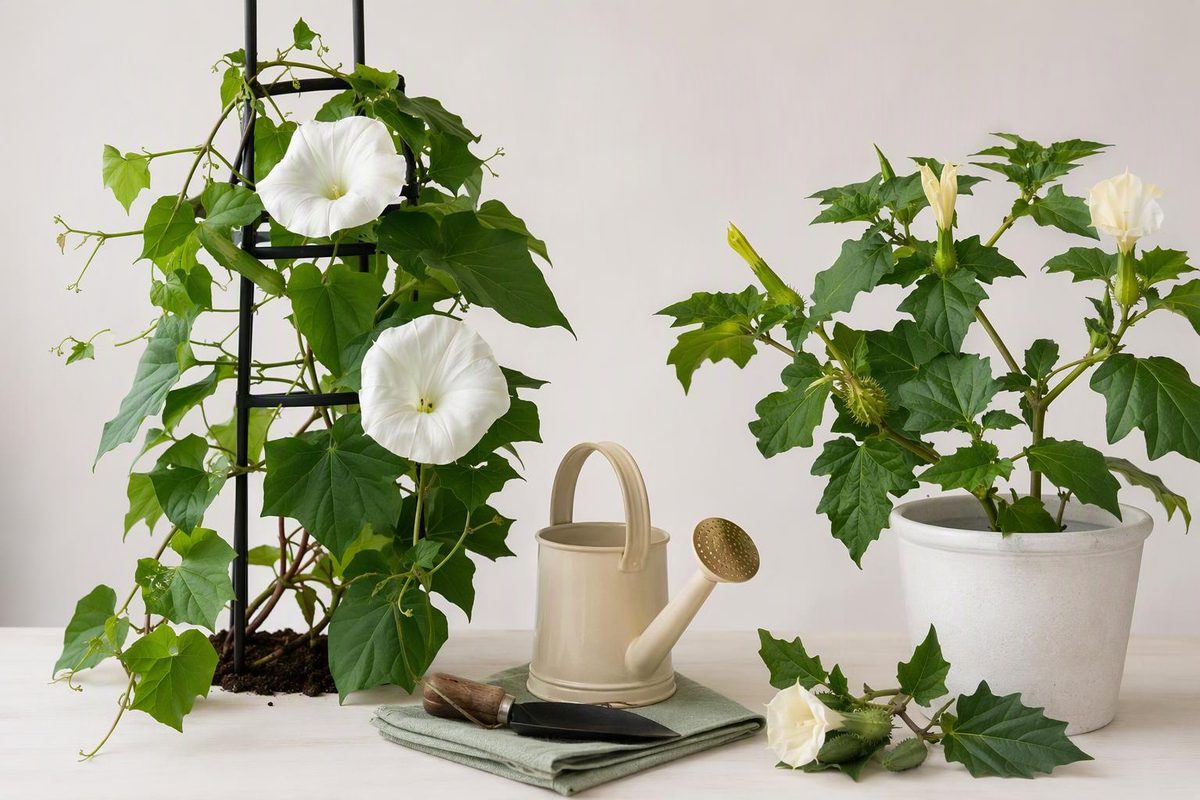
Check the botanical name before choosing a site or following care advice. “Moonflower” can mean the climbing vine Ipomoea alba or a very different plant, Datura, with a much greater poisoning risk. Both can have large, fragrant flowers that open toward evening; a white trumpet-shaped bloom alone does not identify the plant. A published poisoning case involving Datura seeds explicitly distinguishes the two.
Identify your moonflower
These features help separate the white moonflower vine from one commonly confused Datura species. They are not a complete identification key for every plant sold under the name.
| Feature | Moonflower vine: Ipomoea alba | Downy thorn-apple: Datura innoxia |
|---|---|---|
| Growth | Twining climber needing a fence, arbor or trellis | Spreading herbaceous plant, not a twining vine |
| Leaves | Large, hairless, heart-shaped to rounded leaves | Downy leaves with wavy margins |
| Flowers | White, fragrant trumpets opening in late afternoon and closing around dawn | Large, upward-facing trumpets opening toward evening |
| Seed capsules | Small capsules with a pointed tip | Rounded, downy capsules covered in stiff spines |
These descriptions come from NC State Extension’s profiles for Ipomoea alba and Datura innoxia. You may also encounter the spelling Datura inoxia in medical literature.
If a plant is unlabelled or its features do not match, pause before buying, sharing or relocating it. Ask a local extension service or botanical garden for identification using photographs of the whole plant, leaves, flowers and any capsules. Do not taste any part to identify it.
Decide whether the site is safe
Neither plant should be treated as edible. NC State lists low-severity poison characteristics for Ipomoea alba and warns that all parts of Datura innoxia are extremely toxic if consumed. “Low severity” does not mean safe to eat.
As a practical siting precaution, avoid places where children or animals could chew leaves or collect fallen seeds. Keep these plants separate from edible crops and label them with their botanical names. If you cannot reliably prevent access, choose a different ornamental—particularly rather than planting Datura.
For suspected ingestion in the United States, call Poison Control at 1-800-222-1222. For a pet, contact a veterinarian or ASPCA Poison Control at 888-426-4435; a consultation fee may apply. Elsewhere, contact your local poison service or veterinarian.
Care for an established moonflower vine
For a confirmed Ipomoea alba, prioritize light, warmth, drainage and climbing space.
- Give it daytime sun. Night-opening flowers do not make this a shade plant. NC State recommends full sun—at least six hours of direct sunlight daily—and moist, well-drained soil.
- Provide a substantial support. This is a vigorous climber that can grow a dozen feet or more in a season. Guide it onto its own trellis or fence rather than allowing it to cover neighboring shrubs.
- Respond to soil moisture, not a fixed calendar. Check root-zone moisture during hot, rainless weather and water as it begins drying out, aiming to keep the soil moist rather than saturated. Keep drainage clear in containers rather than leaving the roots in standing water.
The NC State growing profile supports the sun, soil and support requirements. In its Arkansas account, University of Arkansas Extension describes a vine growing a dozen feet or more in a year and flowering best in late summer and early fall, provided it does not become too dry.
Lots of vine, few flowers?
Check daytime light and soil moisture before reaching for fertilizer. Also allow for seasonal development: NC State notes that growth accelerates when weather becomes very warm, while the Arkansas account describes the strongest flowering later in the growing season. That regional pattern is a useful clue, not a universal flowering calendar. A healthy young vine without blooms may need time; repeated drying or insufficient sun gives you a condition to correct.
Will it survive winter?
Ipomoea alba is a tender perennial, commonly grown as an annual where winters are cold. NC State lists USDA zones 10–12 and suggests growing it in a large container if you intend to bring it indoors for winter. Indoor space must also allow you to keep it away from children and pets.
Use the hardiness zone versus frost date guide to interpret winter-survival advice; a zone label is not a guarantee for an exposed container or an individual site.
If yours is Datura instead
Do not apply vine-training advice. Datura innoxia needs room to spread and may need staking. NC State recommends full sun to partial shade and moist, well-drained soil; it also advises keeping this species away from tomatoes and potatoes because of its susceptibility to nightshade-family viruses.
Deadheading is not necessary for flowering, but removing spent flowers before capsules develop can reduce self-seeding. Its seeds can persist in soil for years, so check for unwanted seedlings. Before adding it to a garden, check regional suitability with your local extension service: the NC State profile notes that it is considered invasive in some places. A manageable growing site still needs to be a safe one.