
How to water dracaena—and read its leaf problems
Find the right light and watering cues for indoor dracaena, then check brown tips, yellow leaves and sudden leaf loss before changing care.
By Gardener Tips
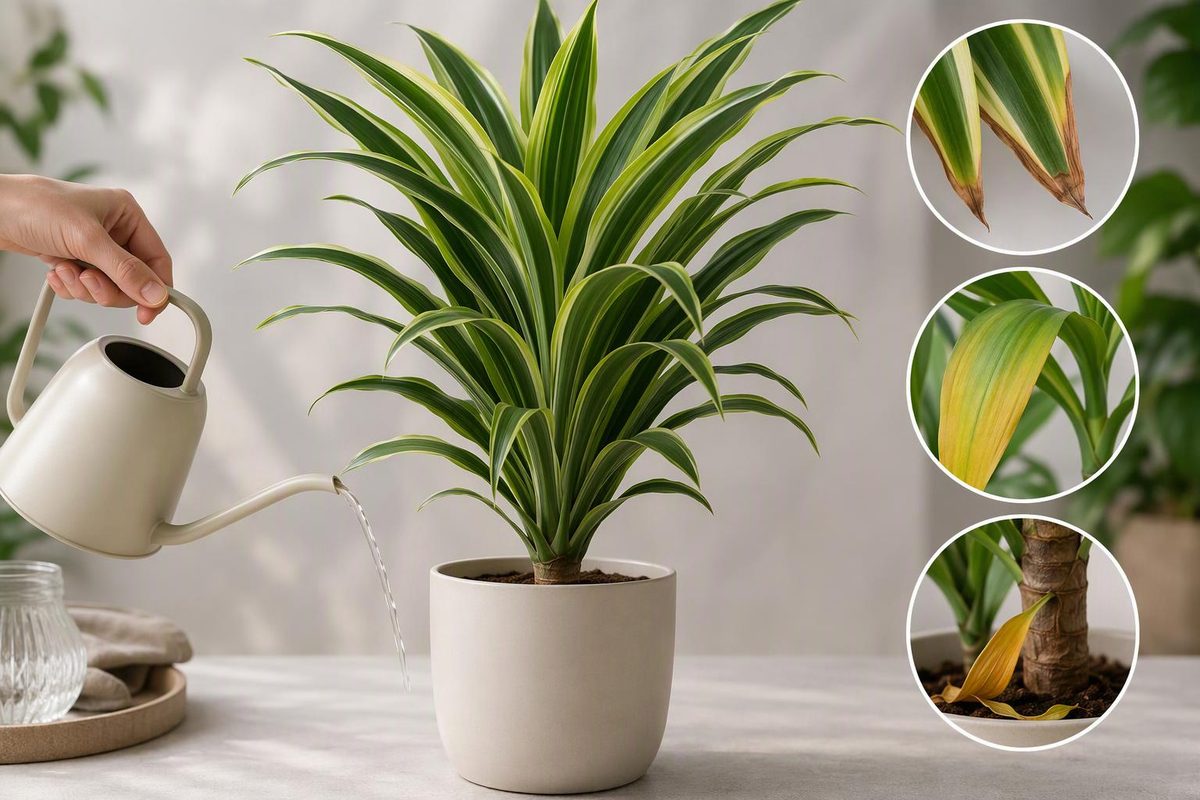
Give dracaena bright, indirect light, let the potting mix dry slightly between waterings, and never leave the pot standing in water. Brown tips alone do not tell you whether the plant needs more water: moisture, humidity, fertilizer and water quality can produce overlapping symptoms.
This guide covers soil-grown, cane-forming houseplants such as dragon tree (Dracaena marginata) and corn plant (Dracaena fragrans), rather than water-grown lucky bamboo.
Water by the pot’s condition, not the calendar
Clemson Extension recommends letting dracaena dry slightly between waterings, then watering thoroughly once the soil surface is dry. For its plants in 4-, 6- and 10-inch pots, grower Costa Farms gives a deeper check: the top 2–3 inches should feel dry. These are starting cues, not a universal weekly schedule.
Use this routine:
- Check before watering. Feel the surface. If it is dry, gently insert a wooden skewer about halfway into the potting mix. Costa Farms advises waiting if it comes out damp or with soil sticking to it; a clean, dry skewer indicates it is time to water.
- Water thoroughly and let excess drain. Use a pot with drainage holes and a well-draining houseplant mix.
- Empty the saucer or outer decorative pot. Costa Farms recommends doing this after about 10 minutes. Do not leave the roots sitting in collected water.
- Check again before the next watering. Do not automatically repeat last week’s interval.
In lower light, dracaena grows and uses water more slowly. Corn plants also generally need less water in winter. If growth slows or the mix takes longer to dry, lengthen the interval rather than giving small, frequent top-ups. See Costa Farms’ light guidance and NC State Extension’s corn plant profile.
Choose bright light without harsh direct sun
Most dracaenas grow best in bright, indirect light, although many tolerate lower light. Low-light tolerance does not mean equally good growth: growth slows and some bright leaf colors may fade. Harsh direct sun can scorch foliage, according to Costa Farms.
A practical starting position is near a bright window, with a sheer curtain if strong sunlight reaches the leaves. Watch the plant’s actual exposure rather than relying on window direction alone.
Keep it away from cold drafts and heating or cooling vents. After a move, note whether damage appears on the sun-facing leaves or whether many leaves drop together; those patterns are more useful than a single brown tip.
Read the leaves alongside the soil
Clemson Extension’s troubleshooting guidance identifies several possible causes for the same symptom. Costa Farms also distinguishes watering-related yellowing from natural leaf shedding. Treat the checks below as a way to narrow the problem, not as a diagnosis from leaf color alone.
| What you see | What to check | First response |
|---|---|---|
| Dry brown tips or edges | Low humidity, inconsistent watering, heavy feeding, fluoride or salt buildup | Check moisture and drainage first; review recent fertilizer use before adding anything. |
| Yellowing leaves while the mix stays wet | Overwatering or poor drainage | Wait to water again, empty collected water and confirm the pot drains. |
| Round dry patches or streaks after stronger sun exposure | Sun scorch | Move out of harsh direct sun or filter the light. |
| An occasional older leaf yellowing, with healthy growth elsewhere | Normal leaf turnover | Monitor rather than changing the whole care routine. |
| Sudden loss of many leaves | Temperature changes, drafts, excess water, poor drainage or pests | Inspect the whole plant and pot; do not assume it is thirsty. |
If brown tips keep appearing
Dracaena is sensitive to fluoride and accumulated salts. NC State Extension recommends trying non-fluoridated water when corn plant leaves brown. If moisture and drainage look appropriate, a trial of distilled water is a reasonable next step; University of Minnesota Extension advice also identifies distilled water as an option. Brown tips do not, by themselves, prove that tap water is the cause.
If the room is dry, NC State Extension suggests a humidifier may help, especially during indoor heating season. Avoid increasing soil watering just to compensate for dry air. Also avoid extra fertilizer as a remedy: excessive feeding can burn leaf tips and margins.
When routine adjustments are not enough
Persistently wet mix plus continuing leaf loss warrants a drainage and root assessment. Clemson links root rot with overly frequent watering or a mix that drains poorly. Inspect leaves and stems for pests too; scale insects and mites are common dracaena problems.
If decline continues, seek a diagnosis from a local extension service or plant clinic before applying a pesticide or repeatedly repotting. Useful details include photos, the pot’s drainage, how long the mix stays damp and recent changes in light or feeding.
Keep dracaena away from pets
The ASPCA lists dracaena as toxic to cats and dogs. Keep it where pets cannot chew it. If ingestion is suspected, contact a veterinarian or animal poison-control service promptly rather than waiting for symptoms.